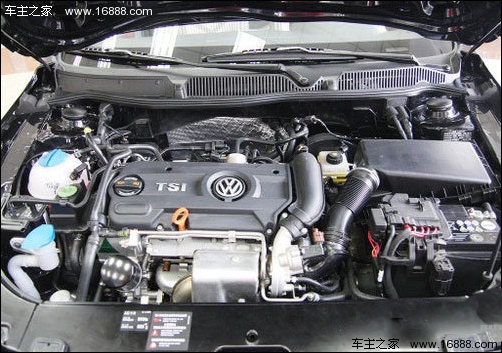
【The owner's family car knowledge】With the advancement of energy saving and emission reduction and the long-term high oil price, there are more and more turbocharged models that can satisfy consumers' pursuit of low fuel consumption and high power. However, for the maintenance of turbocharged models, many car owners still follow the old ideas of the original ordinary models, which often results in a shortened turbine life, and severely even have to replace the turbine. Especially in the cold winter, correct winter maintenance is particularly important for turbochargers that work at high speeds and high temperatures for a long time.

working principle:The turbocharger uses the pressure wave of the engine exhaust to drive the turbine to rotate, and in this way drives the impeller compressor at the other end of the turbine, so that the impeller rotates at a speed of up to 1040r/min, and forcibly presses air into the cylinder to increase The amount of air charged. At the same time, the amount of fuel injected will also increase accordingly, so that the power of a turbocharged engine is increased by 20% to 40% compared to that of a naturally aspirated engine. Due to the complete combustion, the mechanical efficiency is improved, the fuel consumption is reduced, and the exhaust gas emissions a
【The owner's family car knowledge】With the advancement of energy saving and emission reduction and the long-term high oil price, there are more and more turbocharged models that can satisfy consumers' pursuit of low fuel consumption and high power. However, for the maintenance of turbocharged models, many car owners still follow the old ideas of the original ordinary models, which often results in a shortened turbine life, and severely even have to replace the turbine. Especially in the cold winter, correct winter maintenance is particularly important for turbochargers that work at high speeds and high temperatures for a long time.
working principle:The turbocharger uses the pressure wave of the engine exhaust to drive the turbine to rotate, and in this way drives the impeller compressor at the other end of the turbine, so that the impeller rotates at a speed of up to 1040r/min, and forcibly presses air into the cylinder to increase The amount of air charged. At the same time, the amount of fuel injected will also increase accordingly, so that the power of a turbocharged engine is increased by 20% to 40% compared to that of a naturally aspirated engine. Due to the complete combustion, the mechanical efficiency is improved, the fuel consumption is reduced, and the exhaust gas emissions are also improved.
However, because turbochargers often work at high speeds and high temperatures, the temperature at the exhaust gas turbine end of the turbocharger is about 600 degrees Celsius, and the turbocharger rotor rotates at a high speed of 832-1040r/min. If a car equipped with a turbocharged engine does not Proper use and maintenance will increase the failure rate of turbochargers. Therefore, it is understandable that the routine maintenance of turbocharged models will inevitably be more complicated.

[Start and stop]
start up:As with naturally aspirated models, after the engine is started, especially in winter, when the temperature is relatively low, it should be allowed to idle for more than 3 minutes, because oil is an important medium for turbocharged engines, and idling is for the supercharger. Before the rotor runs at high speed, lubricate the bearings with lubricating oil to increase the temperature of the oil. It should be noted that you must not slam the throttle immediately after starting to prevent damage to the turbocharger oil seal.
Turn off:After the engine has been running at high speed for a long time and driving intensely, it should be idling for about 3 minutes when the engine is turned off. Because when the turbine engine is working, part of the oil is specially supplied to the turbocharger rotor bearing for lubrication and cooling. If the running engine suddenly shuts down, the oil pressure drops to zero quickly, and the heat in the turbocharger bearing support shell cannot be dissipated, which will cause the oil trapped in the turbocharger to overheat and damage the bearings and shaft.
As for the definition of long-term and high-speed operation, there are actually no strict time rules. Generally speaking, a long time is a high-speed operation for more than 1 hour, and an intense driving is a high-speed operation of more than 3,500 rpm. But this is not an absolute standard, it depends on the actual driving situation. However, under normal circumstances, the turbo is not so squeamish, and the delayed flameout does not have to be repeated every time.
As for the independent water cooling system, in fact, this device only plays the role of auxiliary cooling. Even if some models are equipped with an independent water cooling system that can still operate after the engine is turned off, it is best to stop and wait for 1 to 2 minutes before turning off the engine after driving for a long time or intense driving.
【Maintenance of key parts】
The most important thing is to ensure that the air filter is clean, but don't underestimate this thing. Many car owners' turbochargers are discarded because of this. When disassembling the turbocharger, be sure to keep it clean, and all pipe joints must be plugged with a clean cloth to prevent debris from falling into the turbocharger and damaging the rotor. Be careful not to collide and damage the impeller during maintenance. If the impeller needs to be replaced, a dynamic balance test should be performed. After reinstallation, remember to remove all obstructions.
In addition, because the turbocharger often runs at high temperatures, its lubricating oil pipeline is subject to high temperature, and the internal oil is prone to partial coking, which will cause insufficient lubrication of the turbocharger bearing and damage it. Therefore, the lubricating oil pipeline must be cleaned after a period of operation.
Always pay attention to check the operation of the supercharger. Before leaving the vehicle and after receiving the vehicle, check the connection of each tube of the airway to prevent loosening or falling off, which may cause the supercharger to fail and short-circuit the air into the cylinder.
【Fuel and Engine Oil】
Fuel:Generally speaking, turbocharged models need to be increased by one mark of gasoline, but with the improvement of turbocharging technology, many models with T models now have "no mouths". For example, Ford's new Mondeo wins 2.0T. It can "drink" No. 93 gasoline as its main selling point, and Volkswagen's 1.4T engine also claims that it can use No. 93 gasoline. Of course, when refueling, try to go to a regular gas station as much as possible. Don’t be cheap because the oil quality is not good, and it’s not good for turbochargers and engines.
Engine oil:There is nothing to say, according to the oil viscosity index specified in the maintenance manual, the choice is made according to the actual car situation. The temperature of each place is different, and the oil selected is also different. What needs to be reminded is that the engine oil must be kept clean, and the oil must be replaced in time if it deteriorates, otherwise the lubricating ability of the oil will decrease, which will increase maintenance costs and even cause the turbocharger to be scrapped.
The last thing to talk about is the life of the turbine. In fact, turbochargers are not so delicate and maintenance is not that complicated. As long as you insist on timely maintenance and develop good driving habits, the normal service life of turbochargers will not be less than 200,000 kilometers. There is not much difference in the actual service life of some cars. Therefore, car owners and friends do not need to be overly cautious and lose the driving pleasure that turbocharged models should have.
Related recommended reading:How to correctly choose and understand antifreeze in winter? Notice to car owners http://news.16888.com/a/2013/1217/311912.htmlIt is recommended to replace the special tires below 7℃ in winter. http://news.16888.com/a/2013/1218/312225.html