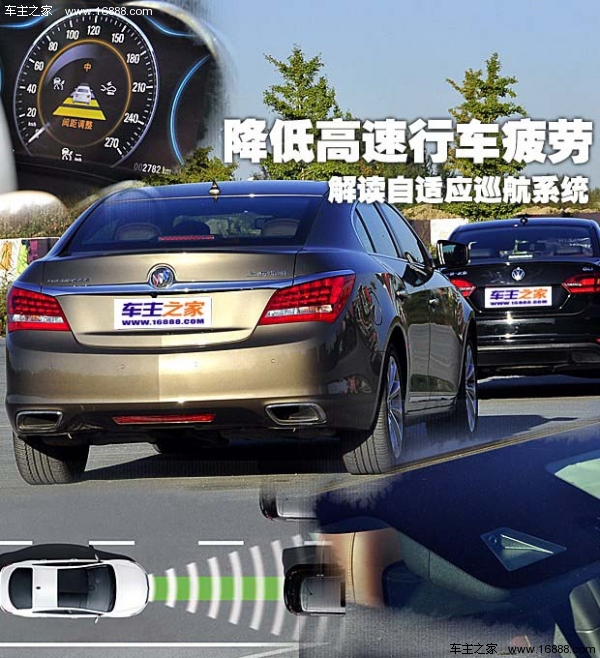
【The owner's family car knowledge】Some people say that technology is constantly evolving because of the existence of lazy people, and I am not commenting on this. However, the continuous advancement of technology does make a lot of originally complicated and uninteresting things simple and interesting. More than a decade ago, when a driver heard about a long-distance high-speed drive, most of them would feel nervous, and experienced old drivers would start to think about wearing shoes that fit the feet. Now, long-distance driving with the help of adaptive cruise has liberated the feet of some drivers. So how does this guy who can automatically reach the preset speed and maintain the preset following distance to do all of this? Why does it sometimes accelerate or decelerate when the adaptive cruise is turned on when entering a curve?
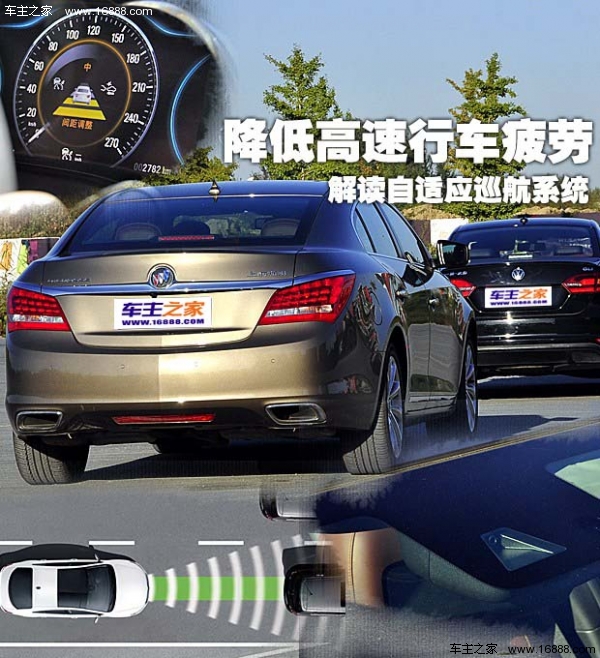
Before answering the above questions, you first need to understand what the structure of adaptive cruise is and what its judgment logic is. After understanding the structure and principle, solving practical application problems will be easy.
■ What is adaptive cruise? Is it different from cruise control?
The first thing to be sure is that there is a difference between adaptive cruise and constant speed cruise. The development of science and technology has helped more and more cars be equipped with cruise control systems. Adaptive cruise is based on the speed control of
【The owner's family car knowledge】Some people say that technology is constantly evolving because of the existence of lazy people, and I am not commenting on this. However, the continuous advancement of technology does make a lot of originally complicated and uninteresting things simple and interesting. More than a decade ago, when a driver heard about a long-distance high-speed drive, most of them would feel nervous, and experienced old drivers would start to think about wearing shoes that fit the feet. Now, long-distance driving with the help of adaptive cruise has liberated the feet of some drivers. So how does this guy who can automatically reach the preset speed and maintain the preset following distance to do all of this? Why does it sometimes accelerate or decelerate when the adaptive cruise is turned on when entering a curve?
Before answering the above questions, you first need to understand what the structure of adaptive cruise is and what its judgment logic is. After understanding the structure and principle, solving practical application problems will be easy.
■ What is adaptive cruise? Is it different from cruise control?
The first thing to be sure is that there is a difference between adaptive cruise and constant speed cruise. The development of science and technology has helped more and more cars be equipped with cruise control systems. Adaptive cruise is based on the speed control of cruise control to further realize the distance. To put it simply, cruise control needs to do only one thing, and that is to meet the driver's preset speed requirements. In addition to reaching the preset speed, adaptive cruise is also responsible for maintaining the preset following distance and following the car. The task of automatic acceleration and deceleration when the distance changes.
■ The history of adaptive cruise
The history of the adaptive cruise system can be traced back to the 1970s. In 1971, the US EATON (Eaton) company has been engaged in the development of this area. Its prototype is the PDC (Preview Distance Control) system proposed by Japan's Mitsubishi Corporation. It combines radar and other processors to detect changes in vehicle distance and warn the driver. The system can also control the throttle opening. Adjust engine power. Since then, Toyota, Honda, GM, Ford, Daimler, Bosch and other companies have also invested in research and development.
■ Structure of adaptive cruise
Generally speaking, the adaptive cruise system consists of three parts: sensors, digital signal processors and control modules. If you use a human analogy, the sensor is similar to the eyes, ears, nose and other organs. It is responsible for sensing the exact position of the vehicle ahead and the vehicle. Common sensors on the market currently include radar sensors, infrared beams, and video cameras. The signal processor is responsible for digital processing of the information received by the sensor, and finally the control module processes the collected information for control. When the system determines that it needs to decelerate, the ABS system will eventually brake the wheels or the gearbox will downshift to reduce the vehicle speed.

● Sensor installation location
At present, the sensors on the market mainly include radar sensors, infrared beam sensors, and video cameras. Different brands and models have different installation positions. Common installation positions are behind the car logo, on both sides of the bumper, below the bumper, and behind the rearview mirror of the car. The main reason for these differences is the different working principles of various sensors, which of course also includes some cost factors.


Since each sensor has its own weaknesses, in the current adaptive cruise system development process, the research and development personnel will form a partner according to the characteristics of various sensors, and jointly provide information for the digital signal processor. For example, radar has a weaker judgment on overlapping objects in the vertical direction. In actual driving, when a vehicle is driving near an overpass, if there are vehicles in front and on the ramp at the same time, the radar sensor has a very low probability of misjudgment; when there are metal signs or even metal waste on the road ahead, the radar sensor also has There is a very low probability of misjudgment. Believe that no one wants to bet their lives, so in order to further reduce the possibility of misjudgment, more and more adaptive cruise systems use two kinds of sensors to collect information.


Do these sensors have no other solution besides partnering to provide information for the digital annunciator? Of course not. For example, a single camera is more limited by hardware and has weaker ability to judge distance. What is the effect of the two cameras on distance judgment? At the just-concluded Tokyo Motor Show, models equipped with dual-camera sensors appeared on the Subaru booth. I believe Engineers have made it meet the actual needs of use.


■ Adaptive cruise system control logic
The speed of the vehicle in front, the speed of the vehicle ahead, the distance between the vehicle in front and the vehicle, whether there is a vehicle in the side lane, etc., are the basis for the control of the adaptive cruise system. Simply put, the control logic of this system is to use sensors to obtain all the information used in driving. When it is found that the vehicle in front is decelerating or a new target that interferes with the driving of the vehicle is found, the electronic control unit sends an execution signal to the engine or braking system to make Related actions. If you find that there is no vehicle ahead, you will restore the set speed, and then it will cycle again and again until you turn off the function.

These contents are only a small part of the control logic. Now more and more vehicles equipped with adaptive cruise control can control the following distance. Will the set following distance change with the speed of the car? When the sensor of the following car What happens when the vehicle in front cannot be identified? These problems are the problems that the adaptive cruise system control logic needs to face. In the test project on the next page, we will practice the above-mentioned problems often encountered in the way of human experience.