
Basic knowledge of auto mechanics
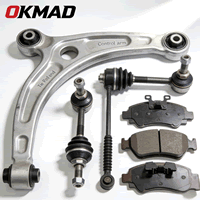
Product Overview
1. Strength refers to the ability to resist permanent deformation and fracture. Commonly used criteria mainly include yield point and tensile strength.2. Plasticity refers to the ability of a material to undergo irre
Key Features
- Meet or exceed OEM requirements
- 2 years warranty
- Strict quality control
- Complete testing from material to product
Quality Assurance
Chemical Analysis
Hardness Test
Surface Test
Dimension Check
Salt Fog Test
Fatigue Test
Fast worldwide shipping Quality guaranteed
1. Strength refers to the ability to resist permanent deformation and fracture. Commonly used criteria mainly include yield point and tensile strength.
2. Plasticity refers to the ability of a material to undergo irreversible permanent deformation. Commonly used criteria are elongation of area and reduction of area.
3. Hardness refers to the ability of a material to resist local deformation, especially plastic deformation, indentation or scratches. Hardness is a criterion for measuring the hardness of metal. Commonly used in production are Brinell hardness (HB, HBS) and Rockwell hardness (HR) test methods. The hardness value is obtained from the experiment, and can be obtained from the relevant book in actual application. Commonly used hardness is Brinell hardness. Brinell and Rockwell hardness values are incomparable, because the test principles are different. The positive relationship between hardness and strength is related to plasticity.
4. Toughness refers to the ability of metal to absorb deformation energy before fracture. The commonly used criterion is mainly the impact resistance of metal materials, that is, the impact absorption energy.
5. Fatigue strength refers to the process in which parts have local permanent cumulative damage in one or several places under the action of cyclic stress, cracks or sudden complete fracture after a certain number of cycles.
6. Addition and subtraction balance force system axiom: When a certain force system acts on a rigid body, adding or subtracting a balance force system will not change the effect of the original force system on the rigid body.
7. Lattice refers to the spatial geometric framework of how atoms are arranged in a crystal. Crystal refers to the regular and periodic arrangement of metal atoms in three-dimensional space.
8. Common crystal structures include body-centered cubic lattice and face-centered cubic lattice.
9. Three-force equili
2. Plasticity refers to the ability of a material to undergo irreversible permanent deformation. Commonly used criteria are elongation of area and reduction of area.
3. Hardness refers to the ability of a material to resist local deformation, especially plastic deformation, indentation or scratches. Hardness is a criterion for measuring the hardness of metal. Commonly used in production are Brinell hardness (HB, HBS) and Rockwell hardness (HR) test methods. The hardness value is obtained from the experiment, and can be obtained from the relevant book in actual application. Commonly used hardness is Brinell hardness. Brinell and Rockwell hardness values are incomparable, because the test principles are different. The positive relationship between hardness and strength is related to plasticity.
4. Toughness refers to the ability of metal to absorb deformation energy before fracture. The commonly used criterion is mainly the impact resistance of metal materials, that is, the impact absorption energy.
5. Fatigue strength refers to the process in which parts have local permanent cumulative damage in one or several places under the action of cyclic stress, cracks or sudden complete fracture after a certain number of cycles.
6. Addition and subtraction balance force system axiom: When a certain force system acts on a rigid body, adding or subtracting a balance force system will not change the effect of the original force system on the rigid body.
7. Lattice refers to the spatial geometric framework of how atoms are arranged in a crystal. Crystal refers to the regular and periodic arrangement of metal atoms in three-dimensional space.
8. Common crystal structures include body-centered cubic lattice and face-centered cubic lattice.
9. Three-force equili
| Material | High-tensile steel / forged aluminum |
|---|---|
| Finish | E-coat / powder paint / zinc plating |
| Standards | IATF / ISO-based process control |
| Warranty | 24 months |
| MOQ | 50-100 pcs per reference |
| Lead Time | 25-35 days after PO |
Passenger Cars
SUVs & Pickups
Commercial Vehicles
Off-road Vehicles
Compatible Brands:
Toyota, Honda, Nissan, BMW, Mercedes-Benz, Ford, Hyundai, Kia, Volkswagen, Land Rover, and more...
Request a Quote
Just for B2B inquiries, no retail please. We'll get back to you within 24 hours.
Related Products
