
Knowledge Post: Analysis of the meaning of common automotive technical terms
Product Overview
When I went to buy a car, did the salesman’s English abbreviation be confusing? What the hell are these? What help is there when I actually use the car? Don't worry, today the host will introduce you to the meaning of co
Key Features
- Meet or exceed OEM requirements
- 2 years warranty
- Strict quality control
- Complete testing from material to product
Quality Assurance
When I went to buy a car, did the salesman’s English abbreviation be confusing? What the hell are these? What help is there when I actually use the car? Don't worry, today the host will introduce you to the meaning of common automotive technical terms. When you buy a car in the future, you can have a good idea, or don't let some of the advanced functions of the luxury car you buy in a confused way sit idle.
ABS
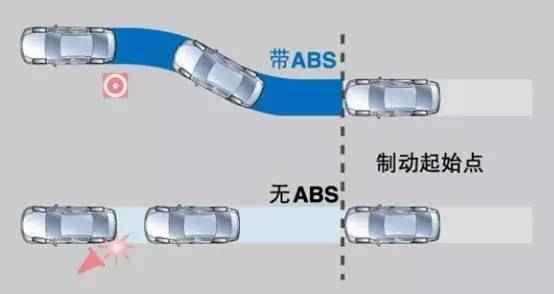
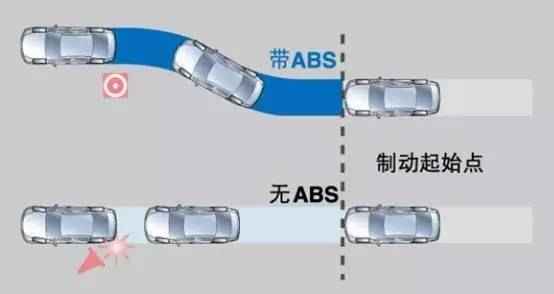
Anti-lock braking system (anti-lock braking system) is referred to as ABS.The role iscarWhen braking, automatic controlBrakeThe size of the braking force, so that the wheels are not locked, and are in a state of rolling and sliding, which can guaranteetireAdhesion to the ground can realize steering operation. As shown below:
ABSThe control channels of the device are divided into four-channel type, three-channel type, two-channel type and one-channel type. Among them, the one-channel type and the two-channel type are rarely used at present. The four-channel type is more advanced than the three-channel type. But don’t follow this analogy, you have to have a "five-channel approach" with the car salesperson. The four-channel type means that the four wheels are individually controlled, and it has reached the top! A few years ago, a car with an ABS function was a symbol of a high-end car, and a three-dimensional "ABS" logo should be posted on the rear to show off.
When ABS works, you may experience the following comparisonCrippledStatus:
(1) A relatively loud clicking sound in the engine room
When I went to buy a car, did the salesman’s English abbreviation be confusing? What the hell are these? What help is there when I actually use the car? Don't worry, today the host will introduce you to the meaning of common automotive technical terms. When you buy a car in the future, you can have a good idea, or don't let some of the advanced functions of the luxury car you buy in a confused way sit idle.
ABS
Anti-lock braking system (anti-lock braking system) is referred to as ABS.The role iscarWhen braking, automatic controlBrakeThe size of the braking force, so that the wheels are not locked, and are in a state of rolling and sliding, which can guaranteetireAdhesion to the ground can realize steering operation. As shown below:
ABSThe control channels of the device are divided into four-channel type, three-channel type, two-channel type and one-channel type. Among them, the one-channel type and the two-channel type are rarely used at present. The four-channel type is more advanced than the three-channel type. But don’t follow this analogy, you have to have a "five-channel approach" with the car salesperson. The four-channel type means that the four wheels are individually controlled, and it has reached the top! A few years ago, a car with an ABS function was a symbol of a high-end car, and a three-dimensional "ABS" logo should be posted on the rear to show off.
When ABS works, you may experience the following comparisonCrippledStatus:
(1) A relatively loud clicking sound in the engine room (the sound of the ABS pump working normally); (2)Brake pedalPulsation, that is, "top" foot; 3 In the final stage of braking, the brake pedal will drop slightly or slowly.
But don't worry, these are normal phenomena, so don't go to the 4S shop to toss the car repairing brother!Those who have not experienced it can slam on an empty roadbrakeFeel it.
EBD
Electronic brake force distributionnic Brakeforce Distribution) referred to as EBD.EBD is actually an auxiliary function of ABS, it just adds a control software to the ABS control computer. It is an effective supplement to the ABS system. It is generally used in combination with ABS to improve the efficacy of ABS.
When performing emergency braking, EBD will automatically compare the rear wheels based on the weight of the car body and road conditions before the ABS is applied.tireIf it is found that the degree of this difference must be adjusted, the brake oil pressure system will adjust the oil pressure transmitted to the rear wheels to obtain a more balanced and more idealized braking force distribution.
A vehicle equipped with an EBD system will automatically detect the adhesion between each wheel and the ground, and appropriately distribute the force generated by the braking system to the four wheels. With the assistance of the EBD system, the braking force can get the best efficiency, so that the braking distance is significantly shortened, and the vehicle is kept stable when braking, and the driving safety is improved. The brake operation of the EBD system in the curve also has the function of maintaining the stability of the vehicle and increasing the safety of the curve.
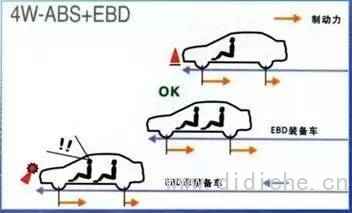
A simple explanation is: if you (brake system) have four children (wheels), and then suddenly all four children are hungry, you without ABS will share all the food equally with each child. Although there is nothing wrong with it, in fact, some of these four children are not too hungry, and some are starving to death, so even distribution is not appropriate. With the EBD function, you can see at a glance which child needs how much food, and then distribute it according to needs, so that all four children can be full.
ASR
Acceleration Slip Regulation (Acceleration Slip Regulation) is referred to as ASR.It belongs to the car's active safety device, also known as the traction control system. It can prevent the vehicle (especially high-horsepower vehicle) from slipping when starting or accelerating, so as to maintain the stability of the vehicle's direction of travel. This system is very practical on special roads with low friction, such as rain, snow, hail, road freezing, etc. When turning, if the driving wheel slips, the entire vehicle will shift to one side. When there is ASR, the vehicle will move along. The correct route turns.
The working principle of ASR: When the driving wheel is slipping, ASR compares each wheelRotating speed, The electronic system judges that the driving wheel is slipping, and automatically reduces immediatelyThrottleThe air intake reduces the engine speed, thereby reducing the power output and braking the slipping driving wheels.
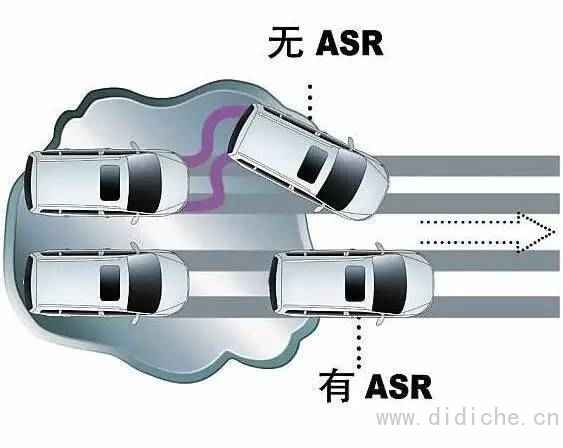
In fact, to put it bluntly, this is a "limiter": if the road is already slippery and the car owner is dying and stepping on the accelerator, it should decide on its own to reduce the knots.ValveAir intake, that is, at this moment, the vacuum controls the accelerator, and the accelerator pedal under the owner's feet is immediately deprived of its real power.
TCS
Traction control system (Traction Control System), TCS for short.The function is to enable the car to obtain the best traction under various driving conditions. When a car is driving, acceleration requires driving force, and turning requires lateral force. Both of these forces are derived from the friction force of the tire against the ground, but the friction force of the tire against the ground has a maximum value. On a smooth road with a small friction coefficient, the driving force and lateral force of the car are very small.
The control device of the traction control system is a computer. The computer is used to detect the speed of the four wheels and the steering angle of the steering wheel. When the car is accelerating, if the speed difference between the driving and non-driving wheels is too large, the computer immediately judges that the driving force is too large, and sends a command signal to reduce the fuel supply of the engine , Reduce the driving force, thereby reducing the slip rate of the driving wheel tires.Computer through the steering wheel anglesensorGrasp the driver's steering intention, and then use the left and right wheelsspeed sensorDetect the difference in the speed of the left and right wheels; thereby judging whether the steering degree of the car is the same as the driver's steering intention.
If it detects that the car is understeer (or oversteer), the computer immediately judges that the driving force of the driving wheels is too large, and sends an instruction to reduce the driving force in order to realize the driver's steering intention. When the tire slip rate is moderate, the car can obtain the maximum driving force. If the tire produces a larger slip when turning, the acceleration ability of the car will be better.The system can use the steering wheel anglesensorDetect the driving state of the car, determine whether the car is driving in a straight line or turning, and appropriately change the slip rate of each tire.
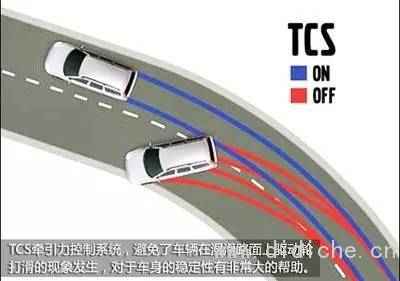
A little confused, right? To put it simply, it's like a babysitter in the car, who can restrain the bear child (the owner) who stepped on the accelerator. Some car owners are also young, and they want to step on the accelerator when they pass right-angle corners. At this time the nanny (On-board computer) To usurp the position to seize power: reduce the throttle as needed to prevent the wheels from losing traction, so that the vehicle can drive safely. But the power of the nanny is also limited, remember!
HAC
Uphill start assist control HAC (Hill-start Assist Control).When the vehicle starts on a steep or slippery slope, the driver switches from the brake pedal to the accelerator pedal and the vehicle will slide backwards, causing difficulty in starting. To prevent this from happening, the uphill start assist control temporarily (approximately 2 seconds at most) applies the brakes to the four wheels to prevent the vehicle from sliding down.
Without the uphill start assist control, the driver must quickly and accurately switch from the brake pedal to the accelerator pedal. However, when equipped with the uphill start assist control, because the uphill start assist control can prevent the vehicle from sliding backward, the driver can easily start the car and operate the pedal calmly.
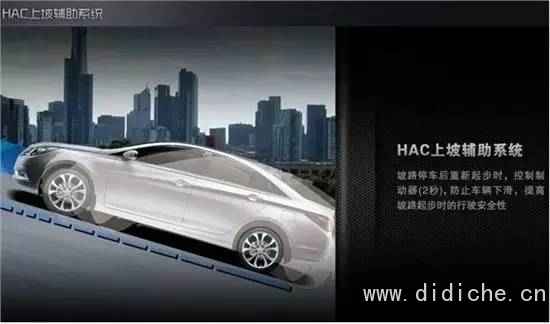
It is not usually used, but it can prevent you from being laughed at by other car owners when starting on a ramp. Such a function actually indirectly reduces the vehicle's technical requirements for the driver, which can be called the gospel of a rookie driver.
AFS ADSVGRS
Variable steering ratioThe names are different in each manufacturer, such asBMWCalled AFS Activesteering system(Active Front Steering,), Audi calls it the dynamic steering system ADS (Audi Dymanic Steering), Lexus/Toyota uses the variable gear ratio steering system VGRS (Variable Gear Ratio Steering), andBenzThe variable steering ratio system is named after the "Direct-Steer" (Direct-Steer).
This kind of system with similar functions adjusts the steering gear ratio according to the speed and steering angle of the car. When the car starts to park, the car speed is low or the steering angle is large, it provides a small steering gear ratio; and when the car is at high speed When driving or the steering angle is small, a large steering gear ratio is provided, thereby improving the stability of the car's steering.
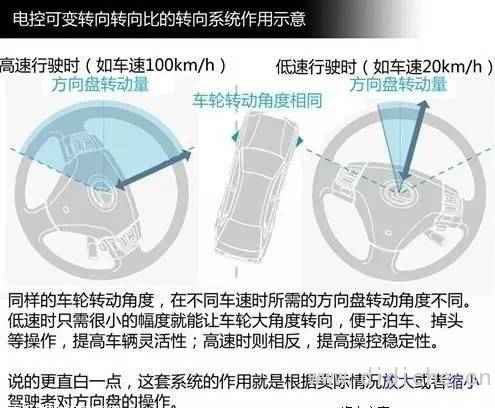
Give a chestnut: It’s obviously the same car, when you are at the crossroadssteering wheelIt takes a half circle to complete the U-turn (is it very convenient), but when cruising at high speed, you also make a half circle just to change the lane (Is it safe? The rapid change of direction of the vehicle at high speed is equivalent to finding death).
ACC
Adaptive Cruise Control (ACC) is an automobile function that allows the vehicle's cruise control system to adjust its speed to adapt to traffic conditions.The radar installed in front of the vehicle is used to detect whether there is a slower vehicle on the road ahead of the vehicle. If there is a slower vehicle, the ACC system will reduce the vehicle speed and control the gap or time gap with the vehicle in front. If the system detects that the vehicle in front is not on the road, it will increase the speed of the vehicle to return to the previously set speed. The main method for ACC to control vehicle speed is through engine throttle control and proper braking.
(1) Through the feedback signal of the distance sensor, the ACC control unit can judge the road conditions according to the moving speed of objects close to the vehicle, and control the driving state of the vehicle; the feedback accelerator pedal senses the force exerted by the driver on the pedal, and ACC control The unit can decide whether to execute cruise control to reduce driver fatigue; (2) The adaptive cruise control system generally works when the vehicle speed is greater than 25 km/h, and when the vehicle speed drops below 25 km/h, it Manual control by the driver is required. Through the upgrade of the system software, the adaptive cruise control system can realize the "stop/start" function to cope with frequent parking and starting situations when driving in the city.
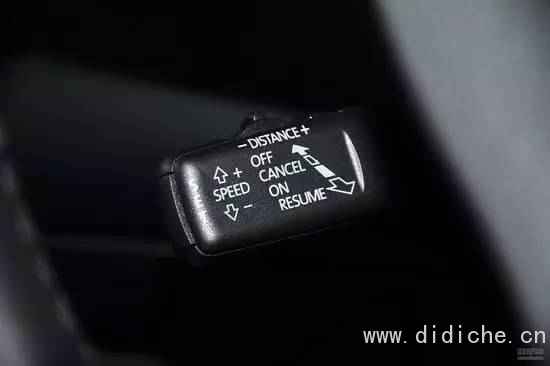
This system is very useful when driving on high speeds, but it is still necessary to pay attention to safe driving and not to take it lightly. I know that you don't hit others, but you must always prevent others from hitting you!
HDC
HDC (Hill Descent Control) translates as "steep slope descent control",As the name implies, it is to allow vehicles to pass through steep road conditions safely under control. This system was first seen in the Freelander model released by Land Rover in 1997, and then extended to the Discovery, the signature car of the same manufacturer. BMW was the owner of Land Rover from 1994 to 2000, so this HDC technology was also used in BMW. The new car is X5.
The principle of this HDC system is to combine the engine brake and the ABS anti-lock brake system to maintain a "low speed without losing tire grip" when the vehicle is descending steep slopes. The HDC system must be set up before entering steep road conditions so that the owner can deal with the steering wheel fully.Because in steep road conditions, any improper pedal operation may cause the danger of loss of control. For example, stepping on the brakes will lock the tires and slip,clutchIt will lose engine brakes, etc. Therefore, after the HDC button is set, the driver must release all the pedals, including the accelerator, brakes and the clutch of the handcart. This way of driving will make the timid car owner flustered when it is used for the first time.
EPB
EPB (Electrical Park Brake)It refers to the technology that integrates the functions of temporary braking during driving and long-term braking after parking, and realizes parking braking by electronic control.Its working principle is the same as that of mechanical handbrake, both throughBrake discandBrake padsThe friction force generated is used to control the parking brake, but the control method is changed from the previous mechanical handbrake lever to an electronic button. The electronic handbrake extends from the basic parking function to the automatic parking function (AUTO HOLD).
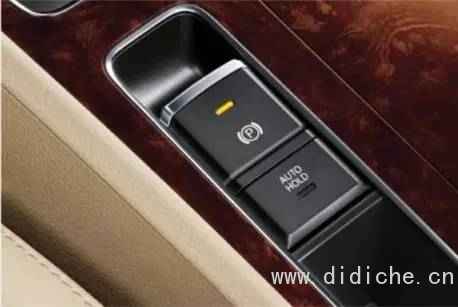
The application of AUTO HOLD automatic parking function technology makes the driver not need to brake for a long time when the vehicle is stopped. And when the automatic electronic parking brake is activated, unnecessary sliding of the vehicle can be avoided, that is, the vehicle will not slip behind. And because EPB does not have a mechanical handbrake handle, it can leave designers more design space.
ESP
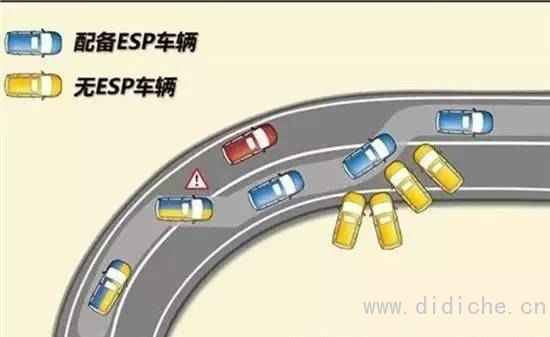
Bosch is the first company to put the Electronic Stability Program (ESP) into mass production. Because ESP is a patented product of Bosch, only Bosch's electronic body stabilization system can be called ESP. After Bosch, many companies have developed similar systems, such as the Vehicle Dynamic Control (VDC), a vehicle stability control system developed by Toyota (Vehicle Stability Control (VSC), a vehicle stability control system developed by Honda (Vehicle Stability Assist Control (VSA), a dynamic stability control system developed by BMW (Dynamic Stability Control abbreviated as DSC).
The ESP system includes ABS (anti-lock brake system) and ASR (drive anti-skid system), which is an extension of the functions of these two systems. Therefore, ESP can be regarded as the most advanced form of anti-skid devices in current automobiles. The ESP system consists of a control unit and a steering sensor (monitoring the steering angle of the steering wheel), a wheel sensor (monitoring the speed and rotation of each wheel), a sideslip sensor (monitoring the state of the car body rotating around the vertical axis), and a lateral acceleration sensor (monitoring the car when turning Centrifugal force) and other components. The control unit judges the running state of the vehicle through the signals of these sensors, and then issues control commands.
The difference between cars with ESP and ABS and ASR is that ABS and ASR can only react passively, while ESP can detect and analyze car conditions and correct driving errors to prevent problems before they occur. ESP is particularly sensitive to oversteer or understeer. For example, when a car turns left and oversteer when the road is slippery (turning too fast), it will flick to the right. The sensor will quickly brake the right front wheel to restore attachment when it senses the slip. Focus on producing an opposite torque to keep the car in the original lane. Of course, everything has a range of degrees. If the driver blindly drives fast, any safety device is difficult to protect.
How does ESP work? Give a few chestnuts:
1. When the vehicle turns left and there is understeer (that is, the speed is too fast to turn). The ESP sensors tell the computer about the understeer information, and then the computer controls the left rear wheel to brake, generating a pulling force and a torque to counteract the understeer tendency of the front of the car pushing to the right.
2. Turn left, insufficient grip on the rear wheel, or excessive pedaling of the rear-wheel drive vehicle (that is, buttocks). ESP will control the brake of the right front wheel while reducing the power output by the engine. Correct the wrong steering posture.
3. When the linear brake is off-track due to uneven ground adhesion. ESP will control the wheels with strong adhesion to reduce the braking force, allowing the car to follow the driving route expected by the driver. Similarly, when braking and turning, ESP will also control certain wheels to increase or decrease the braking force so that the car will proceed according to the driver's intention.
Therefore, with this system, car owners can confidently step on the accelerator regardless of whether it is sunny or rainy. The probability of losing control of the vehicle on wet and slippery road conditions is greatly reduced, and the vehicle's active safety is also higher. Some senior car owners always feel how awesome their driving skills are, but they don't know that dozens of computers in his car assist him all the time. It was like a faint emperor who could not rule the country with a group of loyal ministers around him, always breaking his heart for Jiangshan Sheji. But if the owner of the car is too ruthless, the gods will not be able to help.
| Material | High-tensile steel / forged aluminum |
|---|---|
| Finish | E-coat / powder paint / zinc plating |
| Standards | IATF / ISO-based process control |
| Warranty | 24 months |
| MOQ | 50-100 pcs per reference |
| Lead Time | 25-35 days after PO |
Compatible Brands:
Toyota, Honda, Nissan, BMW, Mercedes-Benz, Ford, Hyundai, Kia, Volkswagen, Land Rover, and more...
Request a Quote
Just for B2B inquiries, no retail please. We'll get back to you within 24 hours.
Related Products
