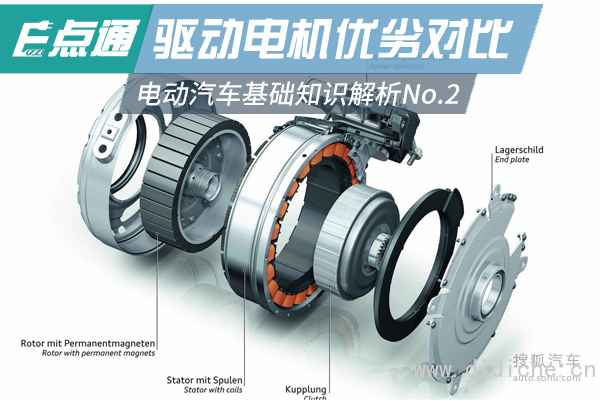
[搜狐汽车E电园]Through the article in the previous issue, we have a certain understanding of the batteries of new energy vehicles on the market. The charging speed and range of the batteries are important, but as the motor that drives the wheels, its performance will directly affect the performance of electric vehicles. Driving performance. In this issue of "E-Diantong", we will talk about the basic knowledge of new energy vehicle motors, and hope that it will be helpful for everyone to understand new energy vehicles.

What characteristics does the motor on an electric vehicle need to meet?
Based on the characteristics of electric vehicles, there are also higher requirements for the motors used. In order to increase the maximum speed, the motor should have a higher instantaneous power and power density (W/kg); in order to increase the driving distance of one charge, the motor should have a higher efficiency; and electric vehicles work at variable speeds, so the motor should have Higher high and low speed comprehensive efficiency; in addition, it has a strong overload capacity, a large starting torque, and a fast torque response. When starting and climbing, the electric vehicle has a low speed, but requires a large torque; during normal operation, the required torque is small, but the speed is high. It has a constant torque characteristic at low speed, an
[搜狐汽车E电园]Through the article in the previous issue, we have a certain understanding of the batteries of new energy vehicles on the market. The charging speed and range of the batteries are important, but as the motor that drives the wheels, its performance will directly affect the performance of electric vehicles. Driving performance. In this issue of "E-Diantong", we will talk about the basic knowledge of new energy vehicle motors, and hope that it will be helpful for everyone to understand new energy vehicles.
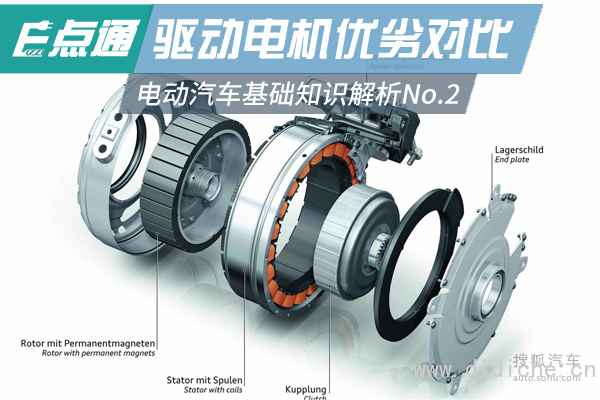
What characteristics does the motor on an electric vehicle need to meet?
Based on the characteristics of electric vehicles, there are also higher requirements for the motors used. In order to increase the maximum speed, the motor should have a higher instantaneous power and power density (W/kg); in order to increase the driving distance of one charge, the motor should have a higher efficiency; and electric vehicles work at variable speeds, so the motor should have Higher high and low speed comprehensive efficiency; in addition, it has a strong overload capacity, a large starting torque, and a fast torque response. When starting and climbing, the electric vehicle has a low speed, but requires a large torque; during normal operation, the required torque is small, but the speed is high. It has a constant torque characteristic at low speed, and a constant power characteristic at high speed, and the operating speed range of the motor should be wide. In addition, the motor should be sturdy, reliable, dustproof and waterproof, and the cost should not be too high.
At present, judging from the current mature motor technology,switchReluctance motors seem to be more in line with the needs of electric vehicles in terms of various technical characteristics, but they have not yet been popularized. Permanent magnet synchronous motors are widely used, such as Kia K5 hybrid, Roewe E50, Tengshi, BAIC EU260 and so on. Both Tesla Model X and Model S use asynchronous motors. In addition, if divided according to the current type, it can be divided into two types: DC motors and AC motors. Through the following table, we can first roughly understand the characteristics of 4 more typical motors.
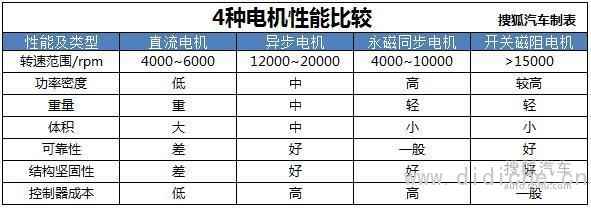
In the early days of the development of electric vehicles, most electric vehicles used DC motors as drive motors. This kind of motor technology is relatively mature, has the characteristics of easy control mode, excellent speed regulation, and has the most extensive application in the field of speed regulation motors.However, due to the complex mechanical structure of the DC motor, its instantaneous overload capacity and the motorRotating speedThe further improvement of the motor is limited, and in the case of long-term work, the mechanical structure of the motor will produce loss, increasing the maintenance cost. In addition, the sparks from the brushes when the motor is running heat the rotor, which will cause high-frequency electromagnetic interference and affect the performance of other electrical appliances in the vehicle. Due to the above shortcomings of DC motors, current electric vehicles have basically eliminated DC motors.
In the field of new energy vehicles, permanent magnet synchronous motors are widely used. The so-called permanent magnet refers to the addition of permanent magnets when manufacturing the motor rotor to further improve the performance of the motor. The so-called synchronization means that the speed of the rotor is always consistent with the current frequency of the stator winding. Therefore, by controlling the input current frequency of the stator winding of the motor, the speed of the electric vehicle will finally be controlled. Compared with other types of motors, the biggest advantage of permanent magnet synchronous motors is that they have higher power density and torque density. To put it bluntly, compared to other types of motors, permanent magnet synchronous motors have the same mass and volume. It can provide the maximum power output and acceleration for new energy vehicles. This is also the main reason why permanent magnet synchronous motors are the first choice for the majority of automobile manufacturers in the new energy automobile industry with extremely high requirements for space and dead weight. However, permanent magnet synchronous motors also have their own shortcomings. The permanent magnet material on the rotor will cause the phenomenon of magnetic decay under the conditions of high temperature, vibration and overcurrent. Therefore, the motor is prone to damage under relatively complicated working conditions. Moreover, the price of permanent magnet materials is relatively high, so the cost of the entire motor and its control system is relatively high.
Compared with permanent magnet synchronous motors, asynchronous motors have the advantages of low cost, simple process, reliable and durable operation, convenient maintenance, and can withstand large operating temperature changes. Conversely, a large change in temperature will damage the permanent magnet synchronous motor. Although asynchronous motors are not dominant in terms of weight and volume, they have a wide range of speeds and a peak speed of about 20,000 rpm. Even if they do not match the secondary differential, they can meet the speed requirements of high-speed cruises of this class of cars. As for weight, battery life The impact of mileage, high-energy-density 18650 battery can "cover" the disadvantage of motor weight. In addition, the excellent stability of the asynchronous motor is also an important reason for being selected by Tesla.
As a new type of motor, the switched reluctance motor has the simplest structure compared to other types of drive motors. Both the stator and rotor are double salient pole structures laminated by ordinary silicon steel sheets. There is no winding on the rotor, and the stator Equipped with a simple concentrated winding, it has many advantages such as simple and firm structure, high reliability, light weight, low cost, high efficiency, low temperature rise, and easy maintenance. Moreover, it has the excellent characteristics of good controllability of the DC speed regulation system, and is suitable for harsh environments. It is very suitable for use as the driving motor of electric vehicles. It was once predicted by experts as a dark horse in the field of electric vehicles.